Second visit this year: Real Madrid Graduate School at the Feyenoord Academy
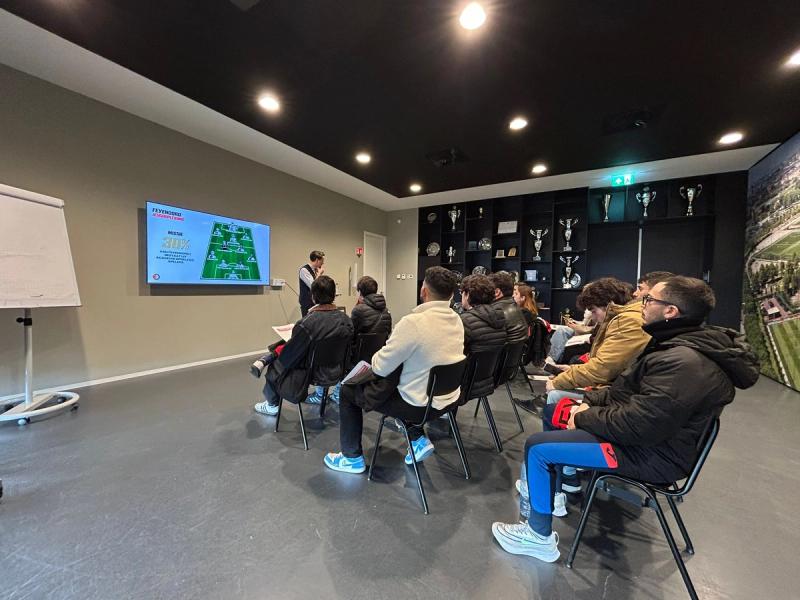
On March 9th, the Feyenoord Academy welcomed another group of students from the Real Madrid Graduate School – Universidad Europea to Rotterdam. Following an earlier visit this year, this group focused on football performance, continuing the strong collaboration between both institutions.
Simone Di Camillo, Director of the Masters in Sports Analytics; Big Data and Sports Data Analysis; and Big Data Deportivo Online at the Faculty of Medicine, Health and Sports at Universidad Europea, reflected on the visit:
“Our visit to the Feyenoord Academy was truly an outstanding experience. What impressed us most was the clarity and consistency of Feyenoord’s working model, reflected in every detail of the training environment and methodology. The quality of the facilities is excellent, but even more remarkable is how they support a well-defined development pathway for the players. Beyond that, I would especially highlight the human aspect of the experience. The way we were welcomed, the openness to share knowledge, and the passion shown by everyone involved made a real difference. It was not only a learning experience from a technical perspective, but also from a cultural and human one. We are very grateful for the opportunity and hope to continue building this relationship in the future.”
During the visit, students attended presentations from several Feyenoord Academy staff members. Zeb Jacobs shared the Academy’s overall vision and structure, while Tammo van Zanten and Jonas Heirbaut highlighted the role of data, innovation, and performance integration. Zurab Amirian provided insights into the Academy’s coaching principles and methodological framework.
The presentations were experienced as insightful, combining strong theoretical frameworks with practical application. The interactive and energetic delivery style contributed to an engaging learning environment, creating a clear connection between the topics discussed and their application on the pitch. In particular, the way data and video analysis are used to support decision-making and enhance performance provided valuable perspectives for the group.
Throughout the program, students gained a deeper understanding of the importance of alignment within the Academy, from coaching principles to overall philosophy and playing style. The combination of structured methodology, performance integration, and attention to the individual player left a strong impression, while also offering valuable perspectives for their own development within football performance.
The visit also encouraged reflection on how different elements within a performance environment can be further connected, both in terms of content and delivery, contributing to open discussions and a valuable exchange of ideas between the group and Feyenoord Academy staff.
The visit once again provided meaningful context to the students’ academic journeys and underlined the value of international knowledge exchange within football development and performance.
Download the Feyenoord App

- Stream Feyenoord One
- Store your Tickets safely
- Live blog during matches
Main sponsor

Strategic partners






Premier League partner

- Feyenoord Rotterdam N.V. 2026
- BTW nr. NL813145673B01
- KvK nr. 24363218